

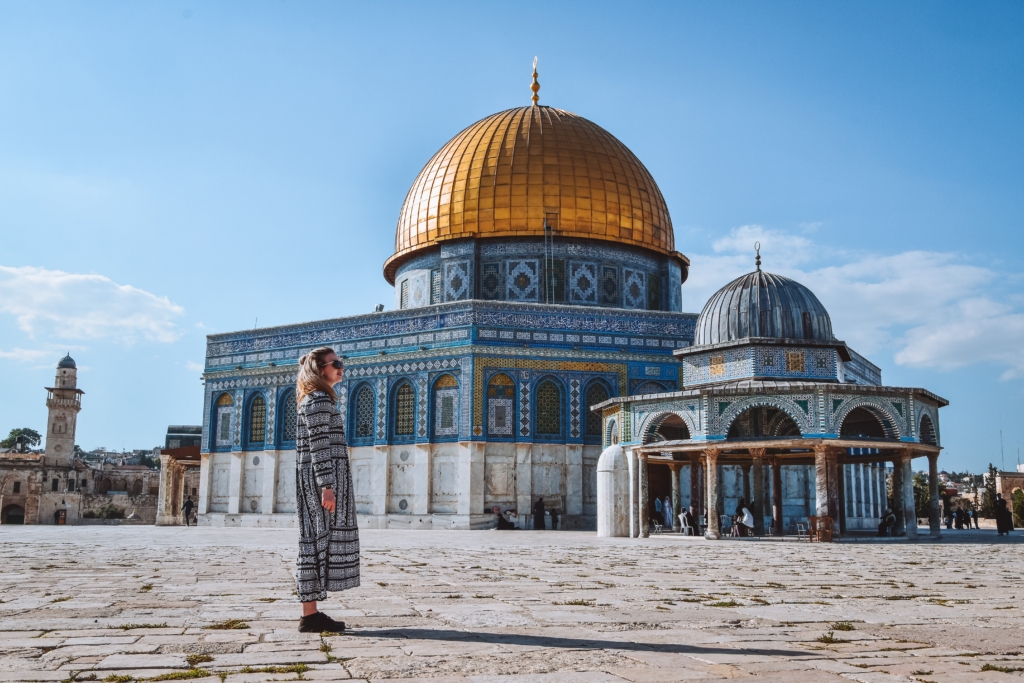
We’ve wanted to visit Israel for a very long time. During our Workaway in Denmark, we shared a house with our (now friend) who comes from Israel. In December last year, we finally managed to fulfill our wish and visited him. In this article, we will answer the questions that most people have before visiting Israel 🙂 We note in advance that we are certainly not experts on Israel, we are only sharing our experience, which may differ from others.
Where to buy the cheapest flights to Israel?
Finding cheap flights to Israel is not difficult, as long as you don’t mind traveling to Austria. It is often possible to get cheap tickets departing from Vienna, which cost around 40 USD. You can fly to either Tel Aviv or Eilat airport. Sometimes there will also be well-priced flights from Prague (our home city), but you won’t get such attractive prices as from Vienna.
From the airport in Tel Aviv, you can easily get to the city center or to Jerusalem by train. You can buy a ticket in a ticket machine (cards are accepted, but not all of them are compatible).

Visa, entry, and exit interview when traveling to Israel
We Czechs can visit Israel without a visa. After exiting the plane, you will be directed to a machine that will take your picture and issue you a blue card – a permit. You must not lose this card during your stay, they require it at all accommodations. You will not get a stamp in your passport.
Entry and exit interviews are often the main subject of discussion on many travel groups. From our recent experience in December 2022, we confirm that there is nothing to worry about. When you enter, you go to a counter, where you present the blue card and your passport. The airport security officer will ask you a few questions, specifically what you will be doing in Israel, whether it is your first time there, what you are planning, and how long you will be staying.
The exit interview was a bit more complicated, but still nothing to worry about. They asked similar questions as when entering – what we did, how long we were there, what we saw + a few personal questions, specifically if we were a couple, if we lived together, where we lived and what we did for a living. At the exit interview, two customs officials took turns asking us the same questions.

Currency and prices
In Israel, the official currency is the New Israeli Shekel (ILS), and one shekel equals approximately 0.26 USD. If you don’t plan to shop at the local markets (which we highly recommend to visit), you’ll be fine with a credit card. If you are going to the markets or smaller shops, we recommend having some cash. Be sure not to exchange money at the airport, where the exchange rate is often unfavorable. We took euros with us and exchanged them in the city center. The only problem we noticed regarding paying by card, was paying for public transport. The machines in Jerusalem absolutely did not want to accept our Czech card. So hopefully you’ll have better luck than us.
Israel is a very expensive country for us, we would compare it to Scandinavia in terms of the prices. The prices here are really high, especially for someone who often travels to Eastern Europe or Asia. In a restaurant, you can practically not eat for less than 16 USD per person. We paid about 24 USD for two beers in a bar outside the center (in our home country it wouldn’t be more than 7 USD). The only thing that somehow keeps its price is coffee… it is around 4,5 USD. The absolute highlight was one grocery shop, where they charged 4 USD for a Chinese soup in a plastic packaging. Israel is not exactly cheap, but we must point out that it is really worth it! We managed to get accommodation in Tel Aviv, about 3 minutes from the beach, for about 78 USD / night. That was a steal 🙂
Security in Israel
Let’s start by saying that nothing dangerous happened to us during our stay. We felt safe everywhere in Israel territory. Israelis are really nice people, if they see you struggling somewhere, they try to help. It varied a lot with the level of English, but everyone tried :).
Security in Israel is a really sensitive topic. It depends on where you are moving. The situation here can escalate very quickly even without previous warning signals. A few days before our arrival, for example, there was a bomb attack in Jerusalem. There may also be danger from Gaza. Most houses in Israel have an anti-missile shelter (we also discovered a public one in Tel Aviv).
Expect thorough security checks when entering all important locations. If you’re heading to the Palestinian Territory, don’t forget to pack your passport!

Dress Code, or how to dress in Israel?
Be sure to dress respectfully in Israel. Keep your knees and shoulders covered not only in temples and important religious buildings. Before visiting the Palestinian Territory, remember that you are headed to a Muslim country. Women should definitely have long sleeves and dresses that are at least ankle length.
Shabbat Shalom! A weekly holiday
Shabbat is one of Judaism’s most important holidays and is held every week. Shabbat is the seventh day of the week, “dedicated to rest and to refrain from work and everyday activities”. What does this mean for you as a tourist? If you are flying into the country on Friday evening (after sunset) or Saturday (before sunset), expect that there is almost no public transport and the vast majority of shops are closed. Shabbat is more strict in Jerusalem than in Tel Aviv. At least we discovered an open gas station in Jerusalem where we could buy some bottles of water.
